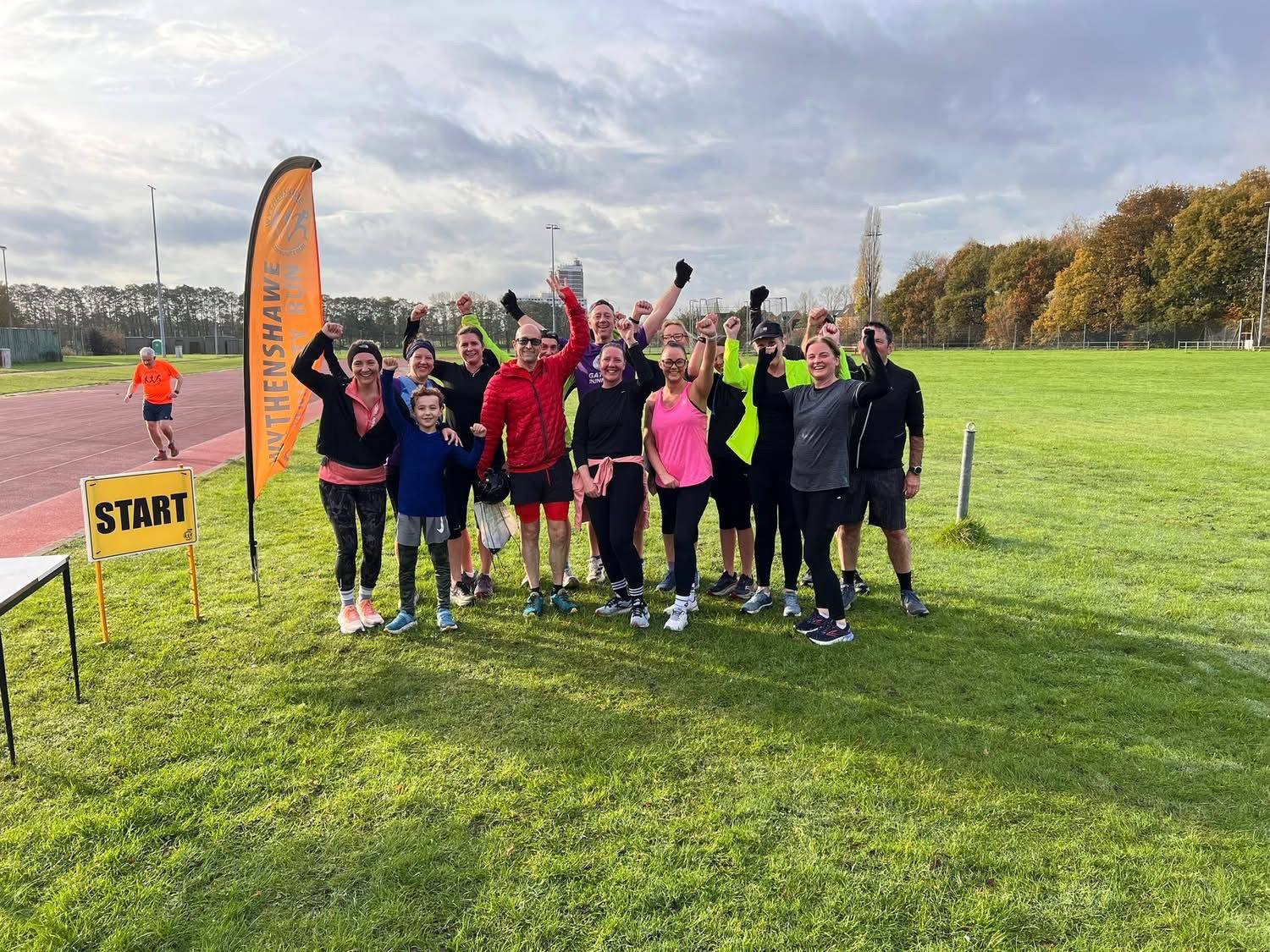
On the 9th of November 2025 I graduated from Couch to 5 km for a 3rd time. Despite having been a regular runner since 2012, a running coach since 2021 and having run numerous marathons (including winning a very, very sparsely attended one), I found myself having to completely stop running and most other exercise in February 2025. The cause was Osteitis Pubis – inflamation and damage to and between your left and right pubic bones (your pubic symphysis). Whilst its a rare condition I hope this post will help any other runner who encounters this condition.
Diagnosis
I thought the story started in September 2021 (we’ll come back to when it actually started!) I was warming up for the Cheshire half marathon; some gentle jogging, ABC drills and then strides and as soon as I accelerated into the first stride my adductors simply refused to co-operate and I was reduced to a painful walk. I went over to a fence did some leg swings, stretches and walked it off and it all felt fine; I ran the race in a cautious 1:21 (which gives you an idea of my level of fitness at the time) and thought little more of it.
My groin and adductors then seemed to grumble on and off from later that month until, late December when I woke up one morning unable to roll over in bed (classic symptom I later discover) and unable to swing my legs around to get out of bed normally. I roll out of bed and crawl to the bathroom, I manage to get a physio appointment later that week and the physio can’t rule out it being related to the inguinal hernia for which I had been waiting for treatment.
The low level grumbling and occasional acute bouts of symptoms continue until I get the hernia repaired in spring 2023 – but not so bad that I can’t continue to train and even manage a 2:57 Marathon earning me a good for age place at London Marathon (which I can’t then use because my hernia surgery ends up two weeks before… This turns in to a recurring theme with me and London Marathon). I discuss the adductor issues with another physio and the hernia surgeon and the physio thinks its possibly related, the hernia surgeon seems a little more doubtful.
I slowly rebuild my fitness again after having a 2 week break from running following the surgery but I’m disappointed and slightly concerned to note that the groin and adductor tenderness and stiffness still seems to be present, albeit not as bad after 2 weeks of time off.
I should also note that I had a herniation of a lumbar disc later in 2023 which meant more stop start training and strengthening exercises.
However, by spring 2024 I was in condition to run a 2:56 at Manchester Marathon, again qualifying for a good for age place for London. But then in mid November 2024 I started having some low back pain, there was something vaguely familiar about it, but it didn’t feel quite like a herniated disc. I took some rest and trained on and off until January, where the acute adductor symptoms suddenly returned. I was again unable to roll over in bed or walk without being supported – this time I self referred to an NHS physio who thankfully didn’t even try to make any kind of diagnosis and just said it was time I was referred to an orthopaedic surgeon for investigation.
Thanks to our amazing NHS (and I realise it doesn’t always work like this) within a month I had this scan result.
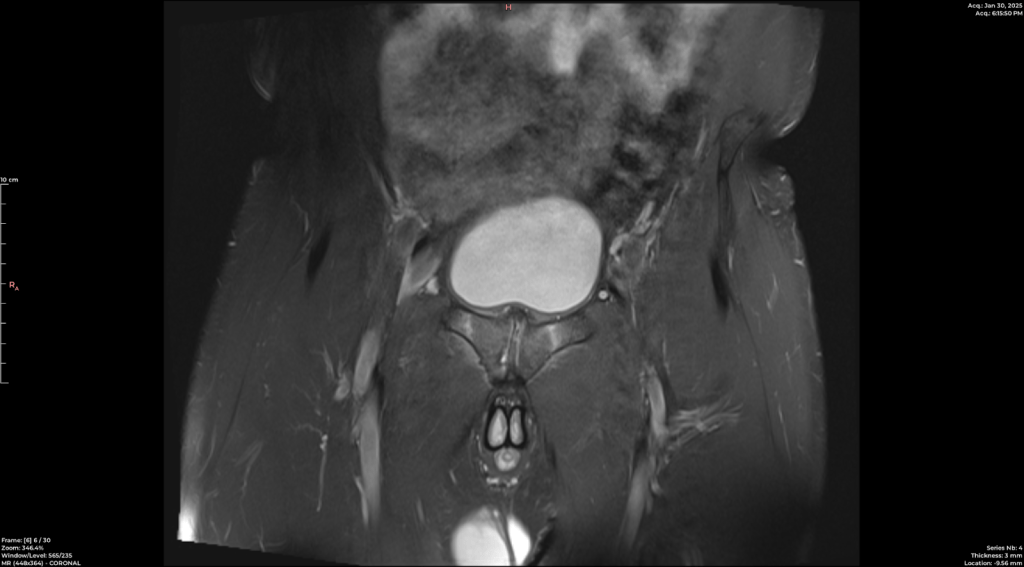
It was with some relief that I heard the news that not only had the MRI pinpointed the issue, but that it was bone bruising to the pubic bone and that with ‘relative rest’ it could be entirely cured. At this point I first heard the term ‘osteitis pubis’ – obviously I now have to Google it and everything associated with it and create a rehabilitation plan (which I got reviewed by my physio before embarking upon).
I was still wanting to know what had caused it, I had reviewed my training diary for summer 2021 (the months directly before the first bout) numerous times with nothing obvious leaping out at me. And then I read an article which described one of the symptoms as low back pain – so I searched TrainingPeaks for ‘low back pain’ and low and behold up come some entries from January 2021, 8 months before the adductor pain and when I look at that section of training diary, what do I see…
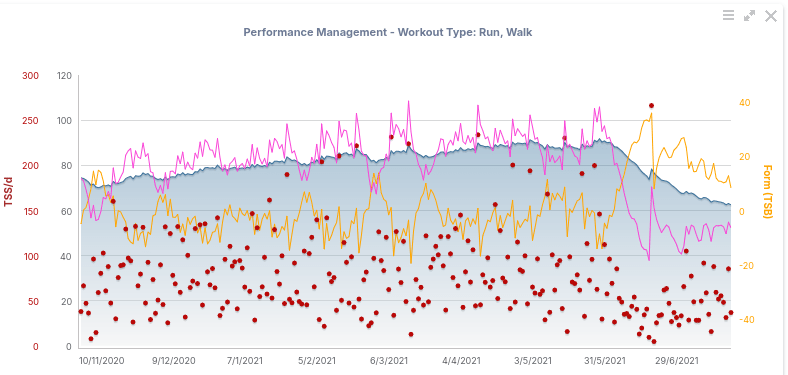
My lead in to Cholmondley Castle Marathon with regular TSB of -20 – I’ve since learned that going over -10 TSB for me strongly correlates with injuries, so what I thought I was doing with -20 two to three times a week, I do not know!
At that point all my running friends gathered around me to support me, coming on walks with me and just being around while I couldn’t run and they were all very concerned about how I must be feeling about having to take a break from running, but in reality, at that point in February ’25, a couple of weeks after the diagnosis, I was just massively relieved that I finally had a diagnosis for an issue that had been plaguing my training for almost 4 years!
I would love to be able to say that I took a few weeks off, followed my rehab plan and then all was lovely again. Unfortunately it was not that simple.
Rehabilitation
The principle of rehabilitating a sports injury is super simple; you take relative rest until the tissues have healed and then you progressively reload them until you build up strength in them to the point that you’re back to normal.
The big problem with this in my case of osteitis pubis is that for most injuries “until the tissues have healed” is generally possible to judge by range of pain free motion returning to normal. Unfortunately what I discovered is that I could have a full range of pain free motion but then I would attempt 5 minutes of running and be fine and then a couple of days later 2 times 5 minutes of running and the following day suddenly I’m back to being unable to roll over again – with no warning at all during the activity that caused it. Which makes rehabilitation horribly frustrating.
Over the next few months I walked, I hiked, I did a fair amount of easy cycling and a little bit of climbing and bouldering. I did some yoga and some very rudimentary body-weight strength training.
It took until July 2025 to be confident of the following:
- Running triggered symptoms
- Copenhagen planks triggered symptoms
- Some combinations of bouldering, intense bike workouts and hiking triggered symptoms, but others didn’t!
It was at this point that my mental state hit its lowest and I genuinely started to wonder whether I would ever run again and to try and put my self in a mental place where I could accept that and just enjoy cycling and hiking.
I’d largely lost any kind of structure to my training and rehabilitation and was not in a good place.
And then I went to Annecy with my eldest son…
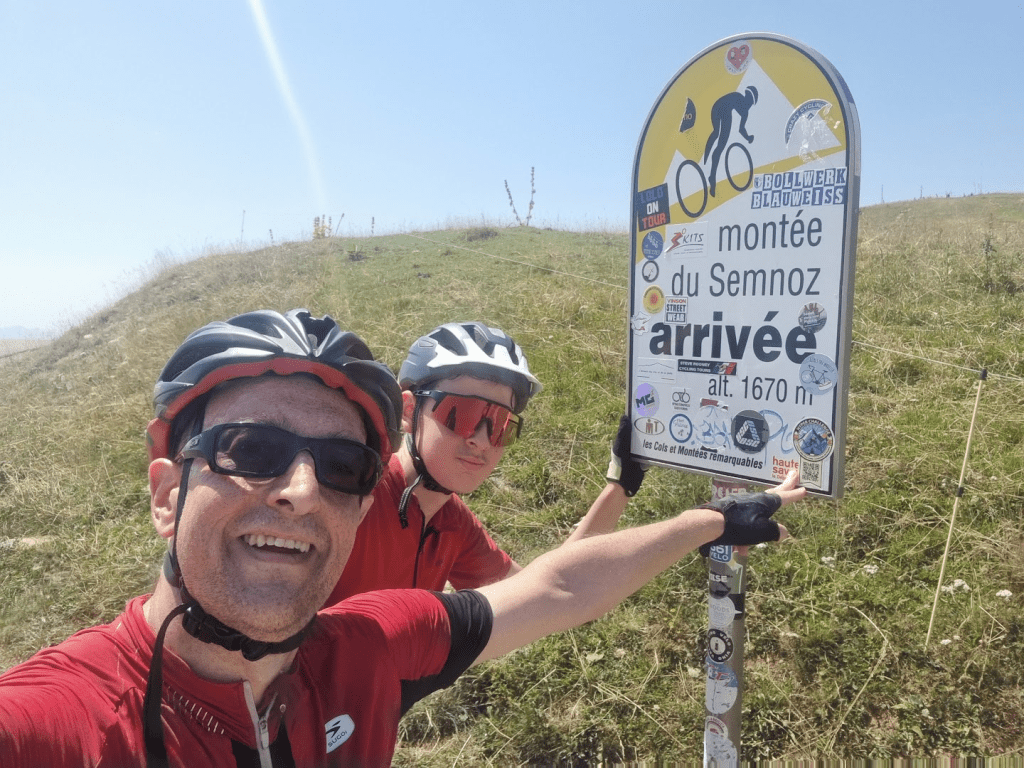
I’ve cycled for utility for as long as I can recall and even enjoyed mountain biking (cross country) for leisure as a teenager, but despite occasional forays into road biking had always been a bit ambivalent about it. But after 2 cycling days in the alps doing a total of 180km and almost 3000m of elevation in those two days at a ‘holiday effort’ I found the love for road cycling that I’d never had before.
We also swam in Lake Annecy and did some hiking and whilst I got some faint symptoms it became clear that I was in a lot better position than I had been earlier in the year and that there was definitely some healing occurring.
Once I got back from Annecy I started a structured plan to get cycling intensity back and my aerobic fitness started to come back again. I had a camping and hiking trip booked for mid September and didn’t want to have an acute bout of symptoms directly before that so, despite feeling ready, I held off trying running until late September.
I’m not going to publish my exact rehabilitation plan since I’m not a rehabilitation professional, but essentially it consisted of:
- Phase 1 – Recovery – minimal impact loading with some very limited strength exercises to try and strengthen tissues and to gauge progress. This probably lasted from February until early August.
- Phase 2 – Strength and Stability – a little more intensity comes in here, but I still didn’t manage to run until the very end of this phase. Yoga and balance exercises come in here and the cycling and hiking get a little more strenuous. I started couch 2 5km as the last part of this phase. This went from August until early November.
- Phase 3 – Functional and Sport Specific – this is where I am now; I’ve used couch to 5 km to return to running, my cycling intensity is up at full intensity, my strength workouts are now back to the standard workouts I was doing before injury but with much lighter weights for the moment. I’m intending to build up the running very conservatively until I can run 10 miles easy 3 times a week and will then start a more structured plan again.
I still see myself as in the rehabilitation phase and I still have some very faint tenderness at times.
But I definitely feel confident that even if I were to have another acute bout, whilst it would be frustrating, I would still be able to feel that there is a path back to full strength, even if it takes a number of years to achieve.
If you’ve got to the end of this then I imagine you’ve read it because you also have osteitis pubis – I imagine your journey will be different to mine, but if you have any questions that I haven’t answered in this then do feel free to get in touch.
 Coach Alex Masidlover